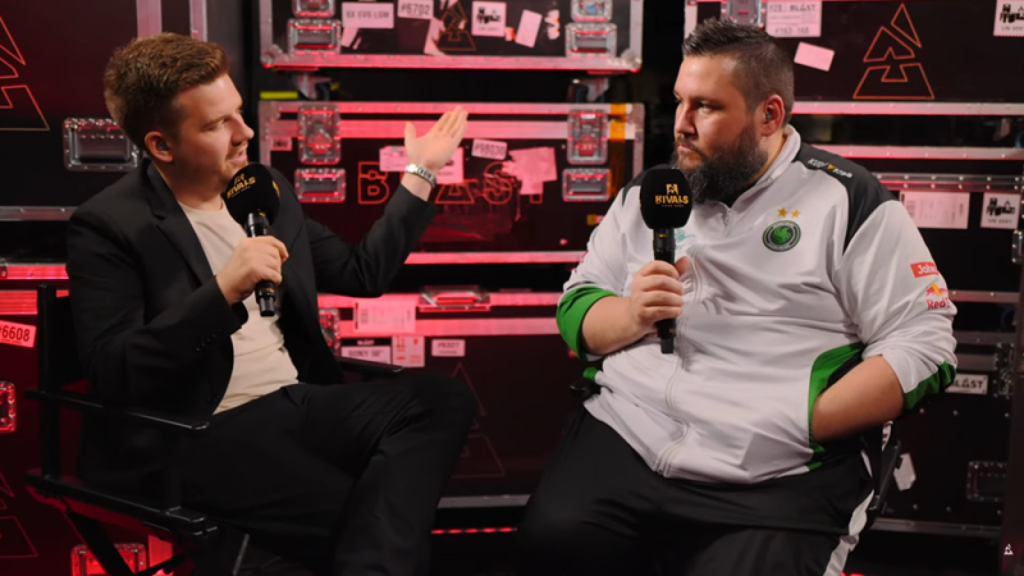
The MIBR organization is preparing a fundamental reset of its Academy project while simultaneously searching for a sustainable path forward for its world-champion women’s Counter-Strike team. In a detailed interview during the Radar em Paris program, Alexandre “Kakavel” Peres, CEO of EZOR, the company that manages MIBR and LOS, laid out a new philosophy for player development and addressed the uncertain state of the female competitive scene.
Kakavel described a shift away from the existing Academy structure, which currently has its roster on the bench, toward a project with a clearly defined beginning, middle, and end. The executive also spoke candidly about the broader ecosystem, revealing that the organization is actively working to place benched players in environments tailored to their specific developmental needs.
The current MIBR Academy lineup has been placed on the bench as part of an internal review that concluded the project had run its course without reaching a natural conclusion. Kakavel explained that the initiative, which has been evolving for two or three years with frequent roster changes, lacked the finite structure the organization now demands. “We are going to give it an end and move to a beginning,” he stated, referencing the project that originally discovered Felipe “insani” Yuji.
The CEO emphasized that the goal of the renewed Academy is not solely to sell players or let contracts expire. Instead, the envisioned endpoint involves either promoting a developed athlete to the main MIBR roster or loaning them to another team to gain experience. He noted that G2 did something similar with kl1m and with MIBR, creating an additional career stage before a player reaches the top tier.
Kakavel provided specific insight into the situation of Lucas “lkz” Vicente and Marcos “Jerr1” Maier, who are part of the Academy reserve bench and remain under contract. He confirmed that the organization is actively trying to help them find a team. The placement process is not a simple transfer, however. The MIBR staff uses quantitative and qualitative analysis to identify what each athlete still needs to develop and then seeks a team whose style and tier will best foster that growth.
The long-term vision involves systematically selecting athletes, pinpointing their strengths and weaknesses through data and observation, and then determining the most logical next step. Kakavel gave a hypothetical example of a new playmaker developed in the Academy who is ready for top-tier competition but blocked by insani on the main roster. In that scenario, the organization would approach other Brazilian teams like FURIA, Legacy, or Imperial, telling them about the player’s positive and negative points, what needs work, and what he can deliver immediately.
Building an Ecosystem to Multiply Talent
Kakavel’s ambition extends beyond producing a single standout player. He wants to replicate the success story of insani on a larger scale, creating an ecosystem that can uncover and polish talent from across Brazil’s vast territory. He drew on his experience from his time with TeamOne, where the organization found players in regions with little to no established competitive infrastructure.
He recounted the stories of Alencar “trk” Rossato, who played with 70 loss in the interior of Goiás, Bruno “b4rtiN” Câmara, who competed on a 60 FPS notebook with loss in the interior of Bahia, and Mario “malbsMd” Samayoa, who dealt with loss in Guatemala. These examples, Kakavel argued, demonstrate that raw talent exists far beyond the traditional scouting grounds and that the Academy’s role is to open doors and provide the targeted development needed for a professional career.
The internal plan is to perform thorough groundwork at the base level to prepare a player for the next step, which is not a release from the organization but a move to another environment to build experience. The goal is to construct a cycle that can produce multiple players of insani’s caliber, leveraging Brazil’s continental size as an advantage rather than a limitation.
- The Academy project will be restarted from zero with a defined beginning, middle, and end, moving away from an ongoing, multi-year cycle of roster changes.
- Benched Academy players lkz and Jerr1 remain under contract, and MIBR is using quantitative and qualitative analysis to place them in teams that match their specific developmental profiles.
- The organization aims to build an ecosystem that systematically identifies talent from underserved regions, develops their weaknesses, and prepares them for promotion to the main roster or a strategic loan.
While the men’s development pipeline is undergoing a structural overhaul, Kakavel also addressed the precarious state of the women’s Counter-Strike circuit and MIBR’s commitment to its reigning world-champion female roster.
Searching for a Path Forward in Women’s CS
Kakavel expressed satisfaction with the results of the MIBR women’s team, which secured the international Rainhas do Clutch title in June, marking the organization’s second championship in that tournament. However, he acknowledged that the broader competitive landscape has deteriorated significantly. “The scene walked toward its end,” he said, noting that several teams have withdrawn and many tournaments have ceased to operate.
Despite these challenges, MIBR intends to maintain its women’s roster and actively search for a viable path forward, both for its own team and for the scene as a whole. Kakavel extended an open invitation to anyone interested in discussing or supporting the women’s CS ecosystem, urging them to contact the organization. He highlighted the work of two key internal advocates, his sports director Carla and former CEO Roberta, as well as the WIBR (Women in Brazil) initiative, which started with women within gaming, with Summit and platforms, and is now expanding into other markets.
The CEO also shared a personal long-term aspiration: to see mixed-gender teams competing for and winning a Major championship. He stated that he sees no inherent limitation preventing women from competing on equal footing with men and believes continued effort toward that goal is essential.
| Subject | Documented Detail |
|---|---|
| MIBR Academy status | Current roster benched; project being restarted from zero with a finite structure. |
| lkz and Jerr1 | Under contract; MIBR using data analysis to find teams suited to their development needs. |
| Women’s team achievement | Won the international Rainhas do Clutch in June, securing a second title in the event. |
| Women’s scene outlook | Described as having “walked toward its end” with teams withdrawing and tournaments stopping. |
Kakavel set out two separate commitments. MIBR will rebuild its Academy from the beginning with a defined development cycle, while keeping lkz and Jerr1 under contract and seeking suitable teams for them. The organization will also retain its women’s roster after its second Rainhas do Clutch title, even as teams and tournaments leave that circuit. He invited people interested in supporting the women’s scene to contact MIBR and repeated his long-term hope of seeing women and men compete together for a Major.

Comments